
Prayers & Scripture Readings
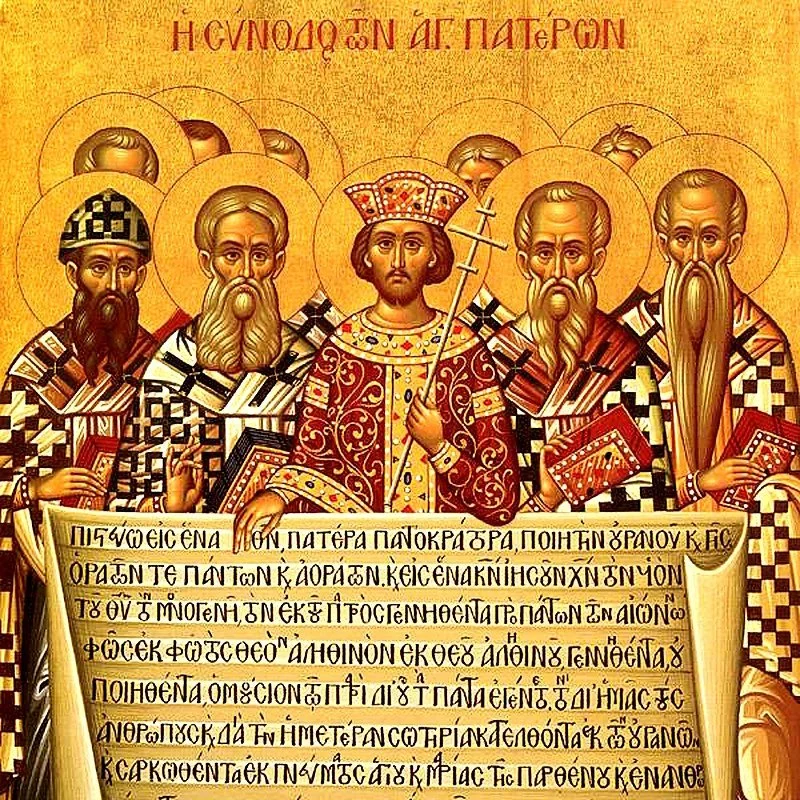 The Nicene Creed
 The Lord's Prayer
 ☩Orthodox Calendar
 ☩Online Chapel
Links preceded by
☩ go to
The
Greek Orthodox Archdiocese of America website.
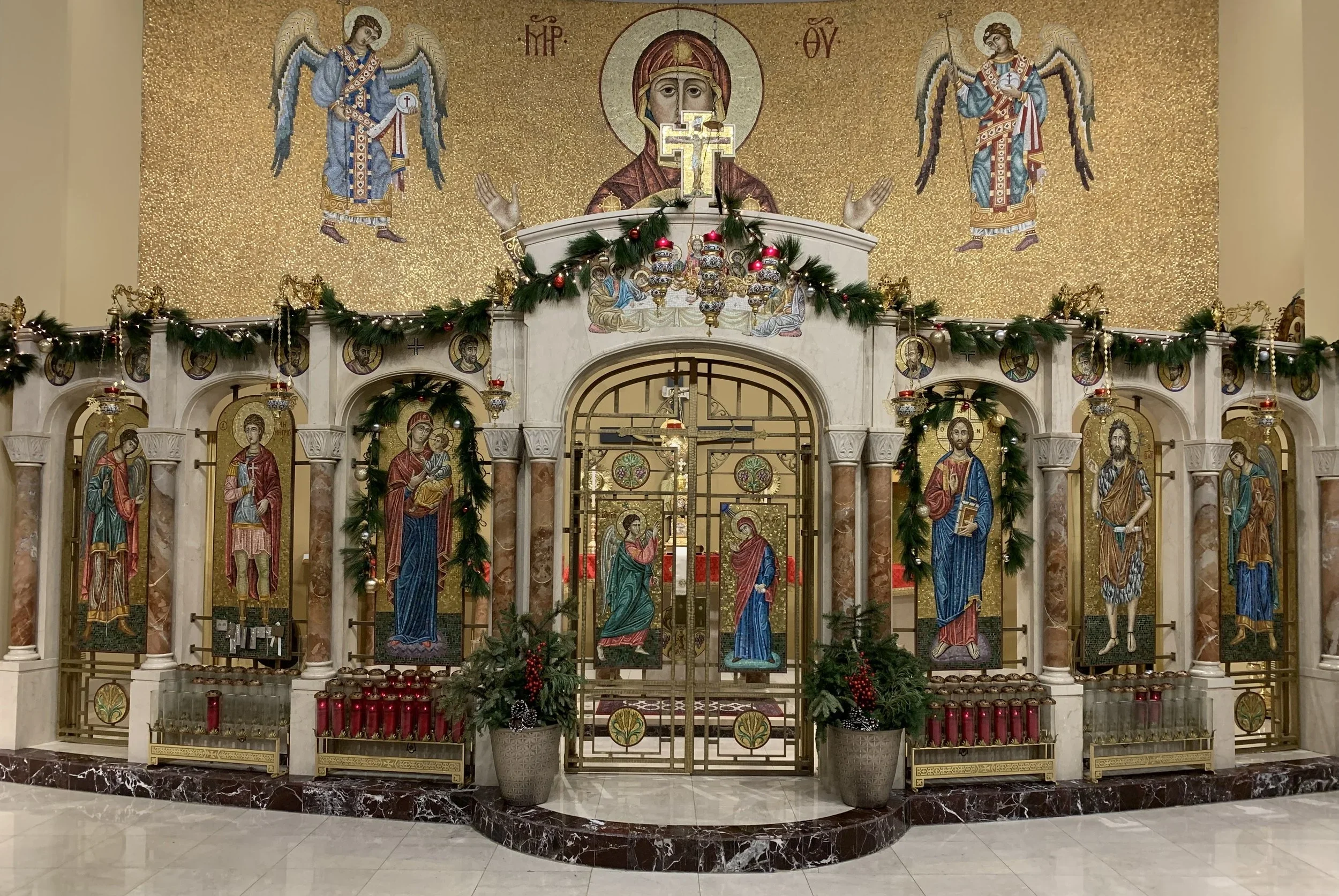
The Nicene Creed
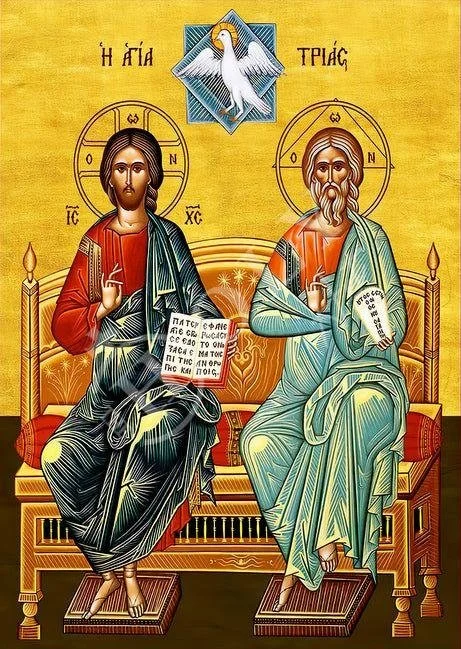
The Symbol of Our Faith
I believe in one God, Father Almighty, Creator of Heaven and earth, and of all things visible and invisible.
And in one Lord Jesus Christ, the only-begotten Son of God, begotten of the Father before all ages;
Light of Light, true God of true God, begotten, Not created, of one essence with the Father, through Whom all things were made.
Who for us men and for our salvation came down from heaven and was incarnate of the Holy Spirit and the Virgin Mary and became man.
He was crucified for us under Pontius Pilate, and suffered and was buried;
And he rose on the third day, according to the Scriptures.
He ascended into heaven and is seated at the right hand of the Father;
And He will come again with glory to judge the living and the dead;
His kingdom shall have no end.
And in the Holy Spirit, the Lord, the Creator of Life,
Who proceeds from the Father,
Who together with the Father and the Son is worshipped and glorified,
Who Spoke through the prophets.
In one holy, catholic, and apostolic Church.
I confess one baptism for the forgiveness of sins.
I look for the resurrection of the dead,
And the life of the age to come.
AMEN
About the Nicene Creed
The Nicene Creed summarizes the doctrine of the Holy Trinity — one God, and yet three distinct persons — The Father, The Son, and The Holy Spirit, and also our salvation through our Lord Jesus Christ. It is often called the “Symbol of Faith”, in Greek, Σύμβολο της Πίστεως. Orthodox Christians recite this creed during the Divine Liturgy and also during baptisms.
The First Ecumenical Council

The Council of Niceae
The Creed was drafted to resolve controversies concerning
the nature of the Son of God, most notably the Arian heresy.
Arius, an Alexandrian presbyter, taught that the Son of God
did not exist throughout eternity, but rather was a
subordinate creation of God the Father. This contradicted
the Gospel of John (John 1:1-3), which states that the
Logos was eternally present with God. In
325
The bishops drafted seven articles, declaring the Son of God to be eternally existent, fully divine and of the same essence (Greek, homoousios) as God the Father. That is, the Son of God is true God of true God, the Word of God by Whom all things were made (John 1:3; Hebrews 1:2), and still fully human. The Creed affirmed all the essential aspects about God the Father and God the Son, including His virgin birth, His death by crucifixion for our salvation, His resurrection, His ascension into Heaven and His Second Coming at the Last Judgement.
The Second Ecumenical Council
A second council was held in Constantinople in
381
Since the Creed was drafted in both Niceae and Constantinople, it is also known as the Niceno-Constantinopolitan Creed.
The Lord’s Prayer
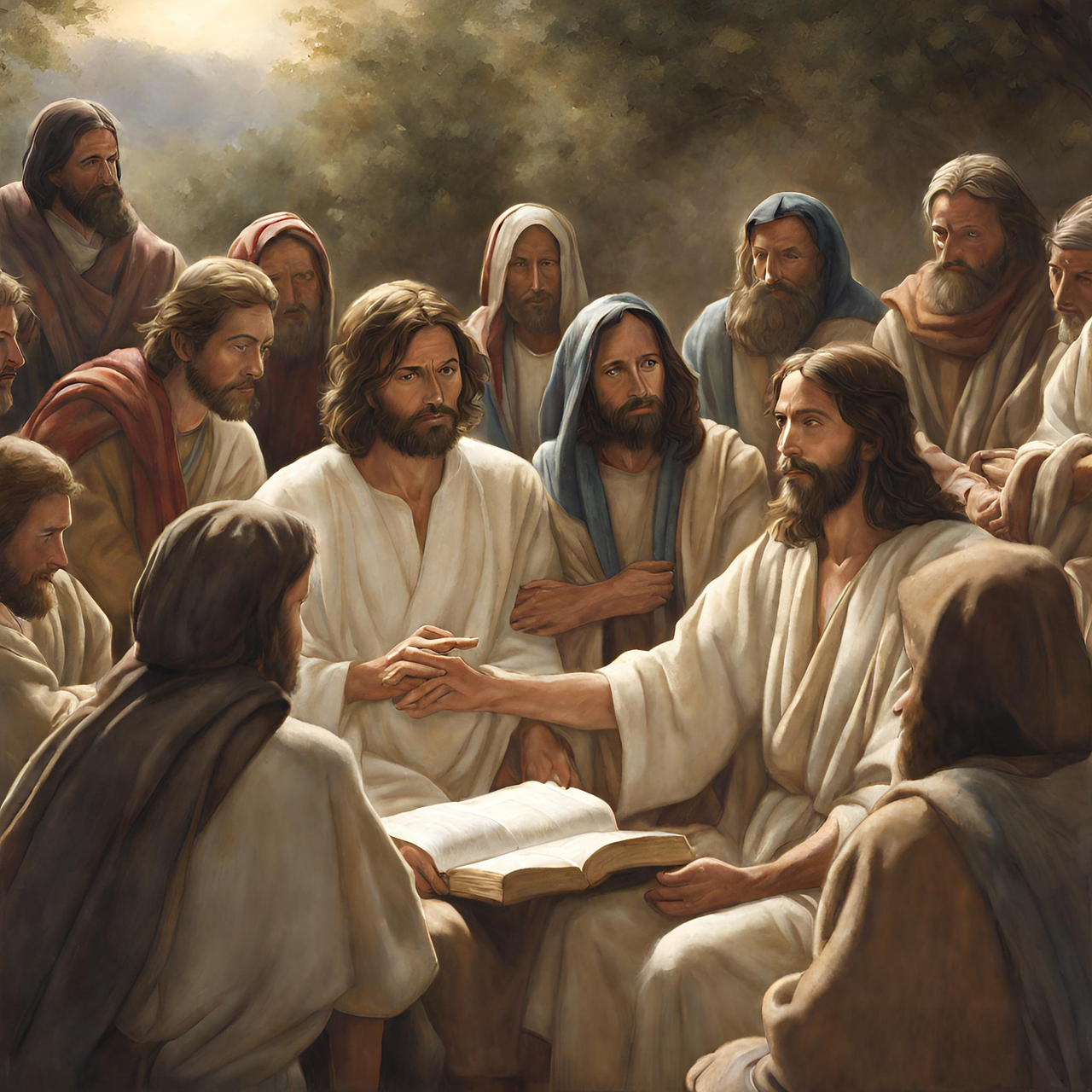
Matthew 6:9-13
Our Father in heaven, hallowed be Your name.
Your kingdom come, Your will be done, on earth as it is in heaven.
Give us this day our daily bread, and forgive us our debts, as we also have forgiven our debtors.
And lead us not into temptation, but deliver us from evil.
Πάτερ ἡμῶν
Πάτερ ἡμῶν ὁ ἐν τοῖς οὐρανοῖς· ἁγιασθήτω τὸ ὄνομά σου·
ἐλθέτω ἡ βασιλεία σου· γενηθήτω τὸ θέλημά σου, ὡς ἐν οὐρανῷ καὶ ἐπὶ τῆς γῆς·
τὸν ἄρτον ἡμῶν τὸν ἐπιούσιον δὸς ἡμῖν σήμερον· καὶ ἄφες ἡμῖν τὰ ὀφειλήματα ἡμῶν, ὡς καὶ ἡμεῖς ἀφίεμεν τοῖς ὀφειλέταις ἡμῶν·
καὶ μὴ εἰσενέγκῃς ἡμᾶς εἰς πειρασμόν, ἀλλὰ ῥῦσαι ἡμᾶς ἀπὸ τοῦ πονηροῦ.
Prayer Before Holy Communion
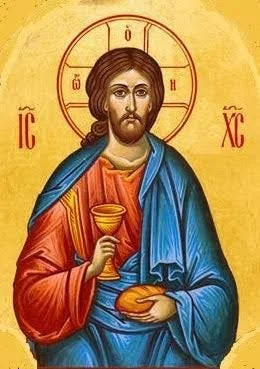
I believe and confess, Lord, that You are truly the Christ, the Son of the living God, Who came into the world to save sinners, of whom I am the first. I also believe that this is truly Your pure Body and that this is truly Your precious Blood.
Therefore, I pray to You, have mercy upon
me, and forgive my transgressions, voluntary and
involuntary, in word and deed, in knowledge or in ignorance.
And make me worthy, without condemnation, to partake of
Your pure Mysteries for the remission of sins and for
eternal life.
Amen
Behold, I approach for Divine Communion. O Maker, burn me not as I partake, For You are fire consuming the unworthy. But cleanse me from every stain.
O Son of God, receive me today as a partaker of Your mystical supper. For I will not speak of the mystery to Your enemies, nor will I give You a kiss, as did Judas. But like the thief, I confess to You: Remember me, Lord, in Your Kingdom.
Tremble, O man, as you behold the divine Blood. It is a burning coal that sears the unworthy.
The Body of God both deifies and nourishes me: It deifies the Spirit and wondrously nourishes the mind.
You have smitten me with yearning, O Christ, and by Your divine eros You have changed me. But burn up with spiritual fire my sins, and grant me to be filled with delight in You, so that, leaping for joy, I may magnify, O Good One, Your two comings.
How shall I, who am unworthy, enter into the splendor of Your saints? If I should dare to enter into the bridal chamber, my vesture will condemn me, since it is not a wedding garment; and being bound up, I shall be cast out by the angels. Cleanse, O Lord, the filth of my soul, and save me, as You are the one Who loves mankind. In Your love, Lord, cleanse my soul, and save me.
Master Who loves mankind, Lord Jesus Christ, my God, let not these Holy Gifts be to my judgment because I am unworthy, but rather for the purification and sanctification of both soul and body and the pledge of the life and Kingdom to come. It is good for me to cleave unto God and to place in Him the hope of my salvation.
O Son of God, receive me today as a partaker of Your mystical supper, for I will not speak of the mystery to Your enemies, nor will I give You a kiss, as did Judas. But like the thief, I confess to You: Remember me, Lord, in Your Kingdom.
Apolytikion of Demetrios
All the world has you, its mighty champion, fortifying us in times of danger, and defeating our foes, O Victorious One.
For as you humbled Lyaios’ arrogance by giving courage to Nestor in the stadium, thus O holy Great Martyr Demetrios, to Christ our God pray fervently, beseeching Him to may grant us His great mercy.
Kontakion of Demetrios
God, who gave you invincible power and with care kept your city invulnerable, royally clothed the Church in purple with the streams of your blood, for you are her strength, O Demetrios.